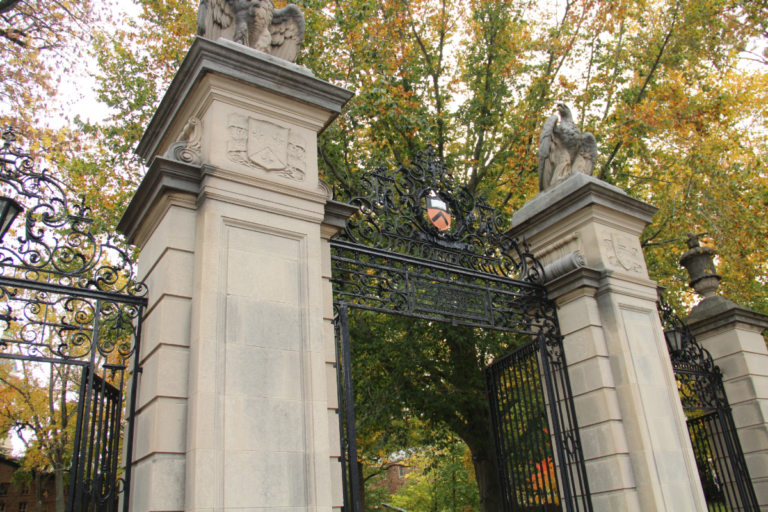
American higher education is in need of serious reform. Campus protests and activist professors are just the tip of the iceberg. But over the past 26 years, Princeton University professor Robert P. George has been building a movement that’s revitalizing American colleges and universities.
In this episode of Giving Ventures, Prof. George joins Peter to discuss the success of the James Madison Program at Princeton, the many centers modeled on the Madison Program that have spread across the country, and the need for deeper reforms to the para-academic institutions that credential and accredit in academia.
Note: This transcript was generated and cleaned by AI.
Peter Lipsett: It’s pretty easy these days to bash on higher education. We know the battles, we know the struggles that take place there — the ideological conformity, professors saying crazy things, students doing crazy things, a complete lack of trust in a lot of places, bloated administration, and on and on. We don’t have enough time to list all the grievances. But the thing is, higher education isn’t going anywhere.
And we need it. We need elite institutions. We need our state colleges and our community colleges. We need it to be there, and we need it, frankly, to function well. But doing that takes real work. It’s going to take courageous scholars, innovative administrators, and donors willing to put pressure when pressure is needed. And of course, let’s not forget the students in all of this — we need students who are eager to learn.
Few people understand the landscape and the hard, continuous work required in all this better than our guest today, Professor Robert P. George — Robby, to many of you listening who have probably interacted with him in the past. He is the McCormick Professor of Jurisprudence at Princeton University and founder of its influential James Madison Program in American Ideals and Institutions. But that is just a portion of everything he is involved with to try to inspire students and to challenge not just Princeton, but universities everywhere, to continue to improve, expand their dialogue, and get better. So today we’re going to talk about what he’s learned building that program, building other programs, the state of higher ed, the state of the right broadly — so many avenues we can go with you. Robby, thank you so much for being here.
Robert George: It’s my pleasure, Peter. Thanks for having me on.
Peter Lipsett: So a lot of people here know your name. We were talking before we recorded — I’ve known you for decades, or at least known of you. And they know you’re an important advocate for these ideas, but you know, I realize I don’t know that portion of your origin story — how did you go… I imagine you wanted to be an academic from the start. That tends to be how a lot of academics are, but maybe not.
Robert George: No, no. No, no.
Peter Lipsett: So how did you not only become an academic, but also decide that you wanted to be an academic — not just going to sit there and publish or perish, but actually try to battle.
Robert George: Well, Peter, I was born and brought up in the heart of Appalachia, in north-central West Virginia. Both of my grandfathers were coal miners, and both were immigrants — my mother’s father from southern Italy, fleeing the grinding poverty of Calabria in those days. My father’s father was from Syria, and he came from a middle-class farming family there; they had an olive farm.
But he was part of a very small Christian minority there that was pretty brutally persecuted by the Ottoman rulers, so he ended up fleeing for those reasons. Both men found work in the mines and on the railroads.
My mom’s father was able to save enough money working in the mines — after twenty or twenty-five years — to start a little grocery store, so he became a small businessman. My dad’s father remained in the mines and as a laborer on the railroads for his entire life, and died of the lung disease that killed so many miners in those days. My father didn’t end up in the mines, simply because he was drafted at age eighteen in 1944 and sent off to fight in Normandy and Brittany, and then to serve in the occupation army after the war. When he came back, although he wasn’t able to take advantage of the GI Bill and go to college — he had other responsibilities with his family — he didn’t have to go to work in the coal mines either. He had skills from the military that served him well. But neither he nor my mother went to college, so I was the first in my family. I’m the oldest of five children, all boys, and my parents brought us up with a firm understanding that we were going to college.
And we all did — but not with a view to becoming academics. That’s certainly not the case. Rather, we were taught that the reason you go to college is so you can get ahead in life, make more money, have more social standing, have a professional job. My dad used to dream of his sons having offices, going to work in an office. That, to him, meant making it in America.
My boyhood really was a Huck Finn boyhood. I grew up hunting and fishing and running through the hills and playing bluegrass music — I’m a bluegrass banjo player, still am, still play a lot and perform sometimes. But I had no idea when I went off to college that I would pursue an academic career. I didn’t even understand that college was fundamentally about truth-seeking, about knowledge-seeking. I really did think it was a matter of just trying to get ahead and rise up in the world.
It was my encounter, early in my college career, in my sophomore year, with a dialogue assigned to me by a professor in one of the courses I was taking — Plato’s dialogue Gorgias — that for the first time opened my mind to the idea that knowledge, truth,
needs to be pursued, is worth pursuing, has value not simply as a means to other ends — getting ahead, making more money, social standing, prestige, celebrity — but for its intrinsic enrichment. That knowledge, that truth, is something we should pursue for its own sake. Now, it has all those other benefits, and they’re fine and good, and I’m all for that. But I could see immediately, upon reading the dialogue, that I’d been thinking about this the wrong way. We really need to be in the business of pursuing truth for its own sake — that’s really one of the things that crucially fulfills us as human beings. And although I didn’t, then and there, sitting in the library on the second floor of what’s called McCabe Library at Swarthmore College, where I was an undergraduate, decide, “I’m going to be an academic,” if I trace my way back, Peter, from where I am now to where my ambitions to become a scholar and a teacher began, it traces to sitting in the library on the second floor reading the library’s copy of Plato’s dialogue Gorgias. And then that was reinforced by the inspiration of some professors. There were a couple of professors of mine I really looked up to, whom I admired so much and learned so much from. These were men who were not pushing any ideological agenda — they were after the truth of things, and I found that so inspiring. I wanted to be like them. So that’s what set me off on my path toward becoming an academic. It was not what I had planned at all from the beginning.
Peter Lipsett: Now, a lot of people today would say that professors are not after the truth, certainly not trying to get their students to ponder the truth. They’re kind of pouring the truth in — and there’s another thought that says the students come in, say what they want to learn, and the professors just reinforce it. Your Madison program is different — it is trying, I think, to get back to some of the dialogue that inspired you. Talk to us about that center — the state of higher ed in general. Maybe you’re more optimistic than I am — but how does the Madison program play into that?
Robert George: Well, education is not indoctrination. Education is not ideology. Education is not feeding people a party line. Education is exposing our students — the young men and women entrusted to our charge — to the best that has been thought and said on competing sides of debated questions by reasonable people of good will, living and dead, so that they, independently, relying on their own insight and judgment, assessing the arguments, the evidence, the reasons on the competing sides, can come to their own conclusions about important questions that are worth thinking about and hard enough that reasonable people of good will do disagree about them — where there have been important arguments on the competing sides of the question.
When education degenerates into ideology or indoctrination — and it happens far too much, Peter, you’re right, it’s happening across the board: elite universities, non-elite universities, state universities, private universities, religiously affiliated, non-religiously affiliated — there’s too much of that, and it’s a disgrace.
It’s shameful. That is not education. That’s not what our vocation is, those of us who are scholars. Our vocation is to help the young men and women entrusted by their families to our charge, to our care, to form themselves into determined truth-seekers and courageous truth-speakers — people who are willing to pursue the truth without an ideological agenda, thinking for themselves, assessing the reasons, the arguments, the evidence, and then willing to speak the truth as best they understand it, knowing they’re never going to understand it perfectly, knowing we’re all fallible, we’re going to make errors, we need to be open to criticism, open to challenge. That’s why free speech is so important to education — but nevertheless, willing to speak their minds and challenge dominant orthodoxies on campus, whether they happen to be of the left or the right. Generally these days there are, of course, orthodoxies on the left, and they’re sometimes enforced by formal mechanisms, and often by informal ones. That’s a shame, and it’s a disgrace, and it should not be tolerated. So in the Madison program at Princeton — which I founded twenty-six years ago now, in the millennial year 2000, July 4th, 2000 — we try to show how it can be done right.
Not with indoctrination, not with ideology. Everyone knows I have opinions — my students all know what they are — but they know they’d better not just try to parrot them back at me. And they know that in my classes, and in other Madison program programming, they’re going to be exposed to ideas and arguments very sharply at variance with my own perspectives. That’s because I want them to confront and wrestle with the best that has been said, not just on my side, but on the other side, or sides — often there are more than two sides to these issues, as well. So you can probably hear a little passion in my voice — it’s something I’m really committed to, something I deeply believe in, and I’ve seen so many universities go astray, so much education degenerate into ideology and indoctrination. I want education back, and the best way I can think to try to get us back to it is to model it — show it can be done, show how it is to be done.
Peter Lipsett: I think modeling it is exactly what you do — the passion that just shone through there was great. But I’ve also seen — I was reading an interview of yours with the Chronicle of Higher Education that, frankly, reading it on the page rather than listening to it, seemed fairly hostile, and you handled it so well. But one thing I think you do that a lot of professors don’t, and I’m curious about your take on this, is that you see the other side’s points. Frankly, that’s not something we broadly do in discourse these days — to say, “I understand where you’re coming from, I see why you would think that,” and then offer something else. You do that, I think, naturally. Is that something you’re teaching students to do as well — to absorb other points of view and also politely give their own perspective?
Robert George: Absolutely. The great nineteenth-century British philosopher John Stuart Mill — of whose political philosophy I’ve been very critical in my own published scholarship — said some things that are true and absolutely right and very relevant today. One of the things Mill said is that a person who knows only his own side of an argument doesn’t even know that. If we’re to understand the truth of things, to get at the truth of things, we have to understand why people — reasonable people, intelligent people, well-motivated people, people of good will — disagree with us. We need to know what their reasons are, and we need to consider those reasons with an open mind, because we know we ourselves are fallible.
We know everybody’s fallible — it’s part of the human condition; there’s nobody who’s not fallible. Catholics might say, well, what about the Pope? But even in Catholic teaching, the Pope’s infallibility is confined to a very, very narrow range of doctrinal matters. We know that we human beings are frail, fallible, fallen creatures. We can make mistakes, which means we might be mistaken. We can’t have utter, absolute, one-hundred-percent certainty, because we’re not God.
So that means we have very good reasons to listen to people with whom we disagree — not just about the minor, trivial, superficial things in life we don’t care much about, but even about the big, important issues we do care about and are deeply emotionally invested in. We still need to be open to criticism, open to challenge, open to hearing their arguments. I can only really say I’m entitled to my opinion when I’ve reasoned my way to it, and I’ve never really reasoned my way to an opinion unless I’ve considered what is to be said on the other side — why some people, as smart as I am, as well-intentioned as I am, as well-educated as I am, nevertheless reach a different conclusion. That doesn’t mean I’m going to agree with them; they might persuade me, they might say something I hadn’t considered before, or show me an error in logic or in one of my empirical assumptions. But I might not change my mind. Nevertheless, I will have been enriched and deepened my understanding, even if I don’t change my mind, by engaging with people who see it differently. That’s what we’ve got to get our students to do — not only so they’ll be determined truth-seekers and courageous truth-speakers and gain the intrinsic enrichment that comes from that, but also so they can be good citizens of a republican civic order.
Remember what we mean by a republican civic order. Sometimes people use the word “democracy” today — it was not a word our founders favored. They identified democracy with mob rule; they favored the term “republican.” What is republican government? What’s a republican civic order?
Well, as Lincoln said, it’s government of the people, by the people, and for the people. Now, all government is government of the people, and all good government is government for the people — even the government of a benign despot who genuinely rules in the interest of the people as a whole and not his group, tribe, clan, family, or himself. What’s distinctive about republican government is that it’s government by the people. But the people can only govern themselves well if they themselves are truth-seekers, if they themselves are independent thinkers, if they themselves are trying their best, recognizing their own fallibility, to listen and to argue in civil and responsible terms. And part of the problem with our republican government today is we’re losing that sense among our people of the importance of being truth-seekers, not being ideologues, being open to argument and persuasion, being willing to engage fellow citizens — not as enemies when they disagree with us, but as civic friends, as fellow citizens who happen to disagree with us. We’re losing that. That’s at the heart of our extreme polarization right now. And as James Madison noted, any republican regime can be put in mortal jeopardy by factionalization, by extreme polarization. So we need to be a people who are themselves truth-seekers if we’re going to be good republican citizens and keep this experiment in government by the people going into future generations. We’ve managed to maintain it — sometimes it’s gotten pretty close to failing, like in the Civil War of 1861 to 1865 — but we’ve maintained it now for 250 years. And if we’re going to hand it on and maintain it for future generations, we can’t be ideologues, we can’t be people who refuse to listen to others, we can’t be people who shut down other people’s free speech. We have to be willing to engage in genuine civil discourse as civic friends, even when we disagree.
Peter Lipsett: Is there a selection bias in who comes to the Madison program — the courses it offers, the different things under it — people who already kind of agree with everything you said, who know there’s a problem and are willing to engage? Or are you also getting people coming out of high school thinking there’s only one way to do things and you just yell until you get your way?
Robert George: Yeah. Well, Princeton, as you may know, Peter, is a small university. In some ways we’re a liberal arts college pretending to be a big research university — Williams masquerading as Harvard. We only have about 7,500 students, including our graduate students, so we’re a third the size of Yale or Harvard or Stanford or similar institutions. But despite being small, we concluded last academic year with 356 undergraduate fellows of the Madison program. If you do the math and look into it, you’ll see that that’s the largest number of any undergraduate fellows program at the university — more than double the size of the next largest, I think.
But if you think it through and look at the circumstances, you’ll see that can’t be 356 conservatives, because we don’t have that many. So yeah, we get a lot of conservative students. I think a high percentage of the conservative students, and religiously affiliated students who are active in their faith, who come to Princeton, do sign up for the Madison program. But an awful lot of our undergraduates are people who are not conservative — they’re more on the progressive side, or toward the center, or something like that. I suspect we probably don’t get very many of the really hard-left students, because they don’t agree that a university is what we think it is, which is a truth-seeking, knowledge-seeking entity.
They think it’s there to advance the cause of social justice, and they’d see the Madison program as contrary to that, so they’re not going to sign up. But I think more moderate students on the left — center-left, or even plain old left, but not woke or extreme — are very comfortable in the Madison program. The reason they’re comfortable is that they know everybody, including me, is going to be challenged with ideas that conflict with their own. If you look at the courses I teach, among the readings I assign you’ll see Karl Marx, Antonio Gramsci — the famous Italian Marxist — and Frankfurt School thinkers like Max Horkheimer, Theodor Adorno, and even Herbert Marcuse, people on the Marxist left. Now, why do I assign those people? Not because I agree with them — I radically disagree with them; I’m on the conservative side. But I think their arguments need to be engaged. So my students are exposed to Marx and Gramsci and the Frankfurt School theorists, but they’re also reading Solzhenitsyn, they’re reading Hayek — critics of socialism, critics of Marxism. That’s not in order to get them to some particular place, because it’s just not my job, and it’s not the Madison program’s job, and it’s not Princeton University’s job, to dictate how they think in the end. Our job is to educate them, to help them become critical thinkers. Now, as it happens, I’ll lay my cards on the table: I have a lot of faith in the power of truth. I really do. I think if you expose students to the best arguments on the competing sides, most of the time they’re going to come down in the right place. And often I think I know what the right place is. But my job is not to dictate that to them — it’s to expose them to the best that has been thought and said and let their own independent minds work, again assessing the reasons, the arguments, the evidence, and lead them to where they’re going to be on whatever the issue is. I think that’s how you make great republican citizens and great patriots, because I do believe in the power of truth.
Peter Lipsett: I think a lot of people who say they’re Marxist, or that they love Karl Marx or some of these thinkers, have never actually engaged with the ideas — they’ve heard one or two snippets, and so they say, that utopianism sounds lovely — and they haven’t. So even if all your course load was just reading those things, you’d probably come around to think, “This is not the way to go.” Okay, so —
Robert George: That’s a very good point. But I’ll tell you — when I teach Marx, I don’t teach him in a biased way. I present him as objectively as I possibly can. If you didn’t know anything about me and just walked into my classroom one day and heard me lecturing on one of Marx’s works, you might think this guy’s very sympathetic to Marx.
Now, that’s the furthest thing from the truth — I am not at all sympathetic to Marx. But I want to present him fairly, and when my students reject him, I want them to reject the real Marx. Now, if they buy it, I think that’s a bad decision, but again, it’s not up to me to dictate where they come out. I just want to present them the best that’s been thought and said, and I have a lot of confidence that in most cases they’re going to get to the truth of the matter.
And I think if you try to indoctrinate students, not only are you violating your trust, your vocation as a teacher, you’re not going to produce a good democratic or republican citizen — you’re just going to produce an ideologue, a zombie. I’m against that. That’s not what education is.
Peter Lipsett: I’m twenty years removed from college. Plenty of people listening are even further removed than that. Obviously you have a course load, but then you have this program. There seems to be some benefit to Princeton just having a program that talks about these ideas — I’m sure it has a speaker series, et cetera, on campus — and also the benefit of a Robby George on campus, pouring these things into students’ minds. But for one of these fellows, what’s the goal? Do you want them to become professors? Do you want them to just live out these ideas? Is it a course load, or extracurricular programming? How exactly does the program work?
Robert George: Okay, so we’re not a major, although we do have what’s called a track within the Department of Politics, which leads to an attestation of achievement in American Ideals and Institutions.
My hope for the future is that that would become a minor, but we’ll see whether that happens and how. The Madison program sponsors courses for students at all levels, hosts speakers, holds conferences.
Our students, three times a year now I think, go down to the Supreme Court, where they’re guests of Supreme Court justices who are friends of mine and friends of the Madison program. They sit in on an oral argument in the morning and then meet with the justice — different justices host them on different occasions.
They have other activities too. We have summer seminars — one held at Oxford University in England, and one on the classical origins of the Western tradition and the American civic order, held in Athens. So we’ve got a lot going on for our students.
Peter Lipsett: That was helpful, thank you. These centers are starting to spread — we’re starting to see more, which is great — more things like the Madison program elsewhere. Some are privately done, some don’t have coursework, some are driven by the state itself, actually put into legislation. In that same Chronicle of Higher Education interview I referenced earlier, you made this great point about avoiding the temptation of creating a “playpen for campus conservatives,” which I thought was a really nice way to put it — that you’re not trying, as you alluded to earlier, to just segregate the conservatives and give them a safe space. You’re trying to do something bigger. So talk to us about the spread of these programs. How are you involved? I know you’re involved with the Chase Center and some of these others. What’s the vision? How should donors be thinking about the expansion of these programs at other schools?
Robert George: Well, it’s interesting. As I said, we founded the Madison program twenty-six years ago, in 2000. We began our visiting fellows and postdoctoral fellows program the year after, in 2001, which began bringing to campus, under the auspices of the Madison program, scholars from other institutions — some very established, like Hadley Arkes and Allen Guelzo, distinguished people in political theory, history, moral and political philosophy, philosophy of law — as well as recent PhDs doing work we found interesting and invited to spend a year at Princeton. Within two or three years it became clear the Madison program was a big success — it was drawing a lot of students on campus, it was growing.
So naturally the question became: could this be replicated at other institutions? Was there something unique about Princeton that meant it could only happen there, or could the Madison program become a model for other institutions? The first several appeared organically — in most cases, people who’d come to the Madison program and spent a year with us, then went back to their home institutions and established programs modeled on the Madison program. That happened at Clemson, with Bradley Thompson; at Furman, with Jenna and Ben Storey; at Georgetown, and some other places. Then, I think around 2012 or 2013, my friend Luis Tellez and my friend Charles Johnson — the retired CEO of the Franklin Templeton funds — got together to see if we could begin planting these kinds of programs more systematically. So we created the Foundation for Excellence in Higher Education. You can go to the website and visit — again, the Foundation for Excellence in Higher Education, not to be confused with Jeb Bush’s very fine K-12 initiative, the Foundation for Excellence in Education. This is the Foundation for Excellence in Higher Education, FEHE, as we call it, and its mission is establishing programs, again modeled on the Madison program, at elite universities around the country, to play the role on campus that the Madison program has played for so many students at Princeton. The Program in Human Flourishing at Harvard was established under a very distinguished professor there, Tyler VanderWeele. The Program in Moral Philosophy was established at the University of Chicago under the leadership of another very distinguished scholar, the philosopher Candace Vogler.
The Program in Markets at the University of Pennsylvania was established under another very distinguished economist, Jesús Fernández-Villaverde. And now I think there are twenty-seven or twenty-eight institutes or programs established in or adjacent to elite universities around the country that are part of the FEHE network, the Foundation for Excellence in Higher Education.
Then, Peter, the next big thing to happen was around 2017–18, when big public universities, often at the behest of legislatures or governors, began to get in on the act on a much bigger scale. The School of Civic and Economic Thought and Leadership at Arizona State University was established, with Paul Carrese, a former Madison program fellow, as its founding director.
Then the program at the University of Texas, originally called Civitas, now the School of Civic Leadership, under Justin Dyer, who’d been with us at Princeton under the auspices of our think tank in town, the Witherspoon Institute. Then, of course, the Hamilton Center — now the Hamilton School of Cultural and Civic Education — at the University of Florida.
Then the School of Civic Leadership at the University of North Carolina, at Tennessee, Knoxville, at Ohio State University — that’s the Salmon P. Chase Program in Civics and Culture. Georgia Tech has just launched its program.
University of South Carolina, under Christopher Tollefsen in the philosophy department, has started its civic education program. So you see this little gospel of ours is spreading. And the scale is much larger than what we have at Princeton or some of the other private universities — you’re talking about faculties at places like the Hamilton School or the University of Texas of fifty or sixty professors, tenured or tenure-track, offering a range of majors and minors. University of Florida is about to inaugurate its doctoral program under the Hamilton School. So very big things are happening. All this is wonderful news — it’s great to see this civics movement, as it’s become known, spreading throughout the country.
But it’s happening very fast, and we’ve pretty much exhausted the supply of professors who are properly credentialed, mission-aligned, and ready to teach in this area. So we now have a labor shortage at the professorial level — we really need more young people.
This is something I wouldn’t have been saying even five years ago, much less twenty-five. But we need more young people to go into academia to staff these programs all over the country, at public and private universities. We need students to get their PhDs in history, political science, moral and political philosophy, public policy, economics — all the civics-related fields. It used to be tough to find a job in academia, and in most areas it’s still tough to find a good tenured or tenure-track job. But in the civics area right now, and this will be true for at least the next decade, it’s a labor seller’s market — we have a shortage of supply.
Peter Lipsett: Is that because we have a weakness in the pipeline?
Robert George: Absolutely. We have a weakness in the pipeline. Part of it is that academia has been a bad job market for a long time, across the board — if you take universities as a whole, enrollments are down, and you have colleges and universities that are closing. Hampshire College closed; there are others on the brink of closing.
But there’s also this: there has been discrimination against conservative scholars going back decades, and in many cases a hostile work environment has been created for people who dissent from progressive orthodoxies on campus. It’s been hard for people to make their way and be successful if they don’t toe the progressive-left party line. When we got into that period of extreme wokeness — cancel culture and all that — conservatives didn’t want to go into academia because it was so hostile. Those who did were often subject to career-damaging, or even career-ending, campaigns of vilification. All of that contributed to the supply shortage we have now, despite the fact that there are lots of students needing education from mission-aligned scholars, and lots of jobs available as a result. We’re benefiting at some level from competition, since all these civics institutions around the country are now competing for talent — and competition is good — but the reality is we have a shortage right now, and that creates some dangers. So we need to ameliorate that problem.
Peter Lipsett: I want to ask about funding for a second. Obviously a lot of philanthropists listening to this — you rattled off a great number of places donors can support. You raise the Madison program’s dollars completely separate from the university, as I understand it; you don’t get a dime from the university. And now, as you mentioned, some of this legislation is creating some of these things, which I imagine means there’s government money going to some of these centers too. So you have very different funding models.
Talk to us about — since you don’t get any money from the university, you raise it all — what does that allow you to do? And what do some of these other centers, and the donors considering supporting them, need to be mindful of, given what can happen when government dollars, or even just university dollars, get tangled up with some of these programs?
Robert George: Well, you’re right that across the country now there are many different funding models. There’s no template here, no single right way to do this — probably lots of wrong ways. When we were established, it was under the administration of Harold T. Shapiro, president of Princeton University at the time, and his chief lieutenant, or provost, Jeremiah Ostriker. When we were established, the understanding was that the Madison program would be part of Princeton University, a program of the Department of Politics, with a certain degree of autonomy — which is great, and I’ve appreciated it very much, and we’ve taken full advantage of it.
But the understanding was that we’d have to raise our own support every year. We’d get the assistance of the Development Office — now known as the Advancement Office — which would help introduce us, especially to alumni sympathetic to what we were doing, who loved our mission and were willing to support us. We’ve had many generous Princeton alumni, as well as people with no association with Princeton whatsoever, who just wanted to see this happen somewhere and have supported us. But we don’t get any allocation of money from the university’s general accounts. We’ve got a budget of something approaching four million dollars a year, and I’m responsible, as director, for raising that money, with the assistance of our advancement office, who’ve been great.
But there’s no annual allocation of funds — I’ve got to raise it. The good side of that is it’s given our program a measure of autonomy I’ve really enjoyed and appreciated. So, for example, when we’ve had hiring freezes, as we did in 2008–2009, or other limitations on hiring, as we actually had last year, and to some extent still have now, we’re not bound by those. We continued to hire to meet our student demand despite university-imposed hiring freezes — we were considered exempt because we weren’t taking university money, we were raising our own.
Other institutions have done it differently — some have big endowments; we do not. The Madison program doesn’t have a general endowment. We have an endowed senior thesis prize and an endowed lecture series or two, I think, but there’s no general endowment we draw a big chunk of money from every year. So different institutions do it differently. If you look at the big state ones — University of Florida, University of Texas — a lot of the money comes from the state legislature, although there are still some private contributions. But my understanding is the bulk of the money there is a legislative appropriation. Same at South Carolina.
Peter Lipsett: And does that worry you? I mean, should political winds change — what’s your thought about that?
Robert George: Yeah, I mean, that’s all — so far, most of these institutions are in pretty solidly red states. Most, not all — Georgia’s a pretty purple state, and they’ve just established a program at Georgia Tech.
And to their credit, I don’t want these institutions to be politically affiliated. I want us to be a million miles from political affiliation — I don’t want us to have dogmas or political ideologies; that’s contrary to everything I believe about our civics programs. But the Republicans, I have to say, have been good about funding these centers. And while I have some criticisms of laws that have been enacted pertaining to education — for example, in Florida, there’s a provision of the Stop WOKE Act that prohibits teaching what they call “divisive concepts.” I’m against that; I think it’s a mistake, I think it’s contrary to the First Amendment, and I think the courts are not going to tolerate that going forward. I mean, I am teaching Marx and Gramsci, but also Solzhenitsyn and Hayek.
And I’m sure the people responsible for that law, if they understood how it can be done right, would have no problem with this. They’re worried about indoctrination — and this does happen, where people are indoctrinated in things like critical race theory, transgender ideology, all that. But I’m against indoctrination of any kind. I’m against right-wing indoctrination as well as left-wing indoctrination. I’m against all indoctrination. It’s not education — in fact, indoctrination is the very antithesis of education.
I’d much rather my students be ignorant than that they be indoctrinated. If they’re ignorant, I might be able to teach them something. If they’re indoctrinated, before I can ever get to the business of teaching them anything, I’ve got to pry their minds open with a crowbar, because they’re victims of a kind of mind control, a kind of thought control.
Anyway, to get back to the subject at hand — I think the Republicans have been pretty good, in the states where the motivation has been Republican, at making sure these places are properly run and have the autonomy they need. I don’t think the winds are going to change. One state, Tennessee, I think, has had a particularly laudable combination of support from both Republicans and Democrats. The folks at the Tennessee Center, led by Josh Dunn, a very fine professor and director of the Institute for American Civics, I believe it’s called, have a former Democratic governor and a former Republican governor on their board, and the Democrats and Republicans there seem to work pretty well together. I’d like to see more of that. But as things expand across the country, into more purple states and perhaps some blue states — Michigan has announced it’s going to build a civic center — you could run into problems with the political football, with\ things changing at the civic center depending on who’s in charge at the state capitol. I’d hate to see that; I hope we don’t. But you’re right to raise it as a potential danger — it’s something we should be aware of and alert to, no question.
Peter Lipsett: Alright, I want to get to one other big topic. I don’t know how you find time for everything you do, but one of the other battles you’ve picked up is around the school accreditation fight, which I think is an under-the-radar conversation. People probably have some vague sense that there’s some collusion among schools to make sure only the “good” schools get accredited. I know University of Austin, UATX, had problems with the accreditation process, but finally did get there. You want to be accredited — to a certain extent you need to be — but not all accreditors like everything that gets taught at places like UATX. So talk to us about this — help donors understand why this is a conversation at all, and what they can actually do about it.
Robert George: Very good. Let me speak here very directly to donors — the generous people who want to help American higher education, who realize that, as Madison said, only a well-instructed people can be permanently a free people. They want to build good citizens; they want to contribute money to education in ways that will really produce thoughtful, independent-minded citizens. How do we do that? Well, a lot of donors have experience with their money being stolen, or with universities trying to steal their money. Now, why do I use such a provocative term as “stealing”? Because I was brought up the old-fashioned way — if you take somebody’s money for a purpose and then use it for some other purpose, it was not that donor’s purpose.
Especially if you use it in a way contrary to the donor’s purpose, you have stolen that money. And I’ve seen a lot of stealing going on in higher education — a lot of people have been victimized by this, a lot of generous people taken advantage of. Anyone should feel free to be in touch with me if you’re negotiating with your alma mater, or if you’re interested in what you can do to make sure your money goes to what you want it to go for.
Please feel free to reach out. I’d be very happy, based on my long experience, to help guide you to make sure your money isn’t stolen. Now, donors have to understand — we need a two-pronged strategy for reforming higher education. The first prong has to do with what goes on directly in the universities themselves — what you see on the stage, what everybody sees. I don’t care whether you’re liberal or conservative — whoever you are, you see what’s going on in American higher education, and either you like it or you don’t.
When I see all this indoctrination and ideology and cancel culture, I don’t like it, and I want to reform it. There are other people with a different political point of view, and a different idea of what universities should be, who love it — they say, “That’s great, we’re training our social-justice warriors, they’re going to change the world and make everything better, God bless Karl Marx.” But everybody sees the same thing — you see what’s happening on the stage. That’s not hidden; it really isn’t. And I think building programs like the Madison program, the Program in Human Flourishing at Harvard, the Program in Markets at the University of Pennsylvania, building institutions like the Hamilton School at Florida, the School of Civic Leadership at Texas, and the ones at North Carolina, Arizona State, South Carolina, Tennessee, Ohio State, and Georgia Tech — those are great, because they model within the university what the whole university should be doing. They’re engines of reform, as well as a place for students who really want an education, especially in civic affairs, to get one — not indoctrination, not ideology, real education, exposed to the best that has been thought and said on the competing sides. So that’s prong one: build infrastructure within existing institutions to model the very best of what universities should be, for the rest of the university and the larger academic world. Then, prong two: what goes on behind the curtain. This is what people don’t see — unless you’re in academia, you don’t see it.
And it’s what goes on, Peter, behind the curtain that dictates who will be on the stage and what they’ll get to say or do there. I’m talking about the institutions, sometimes called para-academic institutions, that do the credentialing and accreditation for higher education.
Organizations like the American Academy of Arts and Sciences, the National Academy of Sciences, the American Association of University Professors, professional associations in every academic field — those play very important credentialing roles the public has no idea about. They don’t know the names of these organizations, don’t know they exist. Everybody in academia knows about them, because they have such control over credentialing. Now, in many cases these are institutions that go all the way back to the American founding, and for generations functioned in a basically non-political way. But in some cases today, those institutions have been ideologically captured and are partly responsible for the unfairness we’ve seen in academia — leading to the collapse of viewpoint diversity and the narrowing of the range of opinions students are exposed to. So the strategy has to be building alternatives to those credentialing organizations, because there’s no way to reform them from within. And then there’s accreditation. Accreditation is basically a cartel — I think there are eight major regional accreditors, ideologically largely captured. But universities, with very rare exceptions, need to be accredited if they’re to function — you need accreditation to receive government support, or to have your students qualify for government-guaranteed or supported loans, things like that. So there’s not realistically an option for most institutions to simply eschew accreditation.
You need accreditation, but if the accreditation cartel is ideologically captured in a way that means your institution has to either toe a line you don’t want to toe, or risk not being accredited, you’re stuck — your university or college or school is stuck. So we’re now in the business of building an alternative accreditor. We’re breaking the cartel, and that institution is called the National Association for Academic Excellence. It’s being built adjacent to the new American Academy of Sciences and Letters, a credentialing organization about four or five years old that honors achievement on a non-ideological basis across the arts and sciences — biology, chemistry, physics, anthropology, sociology, English literature, philosophy, religion, the whole range of fields. And then, adjacent to it, is the accreditor being built, which will mean that universities — for example, in Florida or Texas, or religiously affiliated universities that have suffered under the thumb of woke accreditors for years — Yeshiva, Gordon College, the evangelical college in Massachusetts, Catholic colleges like Benedictine College or the University of Dallas, Brigham Young University, the Latter-day Saints university — all those institutions will have an alternative. They’ll be able to be accredited without capitulating to pressure to conform their programming to woke ideology, the pressure they’ve gotten from the legacy accreditors, as we call them. Donors have to understand that those types of organizations don’t have alumni to support them. If this second prong of the strategy is going to succeed, we need visionary donors willing to support, for example, the American Academy of Sciences and Letters, the new accreditor, so we can actually compete with the legacy organizations, modeling this ideologically nonpartisan, truly educational approach to these things.
Peter Lipsett: And what does it take to make the accreditor credible?
Robert George: It’s certification by the federal government. Currently the certifying authority is within the Department of Education. If the Department of Education remains, it’ll remain there, I assume; if it’s abolished, it would have to move to another department. But at the end of the day, it’s going to have to be government certification. We’re working through the process right now of getting certification for the new accreditor. It’s a complicated process — it’s going to take about four years.
Peter Lipsett: Wow. So not an overnight change, but the long-term thing, as you say, is a big thing behind the curtain, then, that allows more University of Austins, more universities to rise up, create competition, and challenge some of these organizations.
Robert George: Exactly right. Exactly right. And if there are donors who see the need to transform education by changing things at that credentialing and accreditation level, please be in touch with me — there are things you can do to make this happen.
Peter Lipsett: That’s great. Well, there’s a whole other set of questions I could go to, but you’ve been very generous with your time, and I know you have a full course load and plenty to do. So we didn’t even get into what it means to be on the right today — that’s a whole other conversation I was eager to have with you. Maybe we’ll do a round two and dive into those more ideological questions one day. But Professor —
Robert George: I’d be delighted to do that, Peter. Let’s get back together.
Peter Lipsett: Good. Well, Professor George, thank you so much — thank you for all you’re doing to reform higher ed and expand the minds of the students coming through the program. That really is the important part.
Robert George: I appreciate that. Thank you, Peter.
Peter Lipsett: Truly, if all we did was open more and more programs like what Robby George has built at Princeton, and at some of these other elite colleges around the country, we would be trending in the right direction. As Professor George says, there is something important that comes from modeling discourse, modeling these debates and discussions. And in our role as donors, we can encourage the expansion and development of new institutions all across the country, at schools we attended or didn’t attend. Certainly the dollars we spend toward those have got to be better than going to the annual fund, where who knows where it’ll end up. So I encourage you to look at the institutions you support — maybe your alumni institutions — and see if some of these programs exist there. Can you fund them directly? That’s also an important donor-intent mechanism, to know where your dollars are going.
You can look at the Foundation for Excellence in Higher Education website — we’ll link that in the show notes — to see where some of these centers are. You can also look at past guests like the Open Discourse Coalition, operating at Bucknell and expanding its influence elsewhere, doing similar things. These are important pieces of campus life that need to be built — they don’t happen without energy from donors and from education entrepreneurs like Robby George.
I’m glad we could also talk, at the end, about that behind-the-scenes aspect of credentialing and accreditation. It’s important — it’s a complicated mess, with a lot of nuance and things going on behind the scenes — but it’s a piece that really matters if we’re going to expand institutions. There’s a debate about whether we should build new institutions or reform the ones we have. Well, we can always be reforming the ones we have; we can’t build new ones unless we do something about this accreditation problem. And you can support all the different organizations we’ve talked about here through your fund at DonorsTrust. And if you’re listening and don’t yet have a fund at DonorsTrust — well, why not? We encourage you to do so. We would be so honored to be a partner in your philanthropy. Go to donorstrust.org, look around the website, reach out to us, schedule a call with me or one of our philanthropic advisors, to see how we can help you maximize the impact of your giving in higher ed, or whatever issue set really matters to you. Well, we’ll be back with another episode soon. Until then, thank you for being a giver. We’ll talk more soon.